TikTok Shop Germany: Why You Need a German Company to Sell in 2026
When TikTok Shop launched in Germany in March 2025, it took only twelve months to climb into the top 15 online retailers in the country. For sellers from abroad, and even for many domestic brands, the platform has become impossible to ignore. But there is one practical hurdle that catches most applicants by surprise: TikTok Shop Germany expects you to operate through a locally registered business. We have reviewed the current TikTok Shop seller policies and collated everything you need to know about how to start selling on the platform in 2026.
The good news is that setting up a German limited company for TikTok Shop is not as complicated as it sounds. The challenging part is understanding which legal form to choose, how to satisfy TikTok’s verification process and what compliance obligations come along with it. This article gives you the big picture; the four follow-up posts in this series cover each step in detail.
What is TikTok Shop and why Germany matters?
TikTok Shop is the e-commerce layer integrated directly into the TikTok app. Buyers no longer leave the platform. They discover a product in a video or livestream, tap the product tag, check out, and receive the order at home. For sellers, this turns entertaining content into measurable sales without the friction of traditional online shops.
Germany was officially added to the TikTok Shop network on 31 March 2025, alongside France and Italy. With over 27 million monthly active TikTok users in the country, Germany represents the largest single TikTok audience in the European Union. Around 61 % of those users are under 35 and contrary to what many assume, the platform’s revenue does not come exclusively from Generation Z (more on that below).
For brands selling fashion, beauty, lifestyle gadgets, food, fitness accessories or home products, Germany is now a strategic priority. And because TikTok’s algorithm favours locally registered sellers in search results, having a German company is more than a regulatory checkbox — it is a competitive advantage.
TikTok Shop Germany in numbers (2025–2026)
If you are weighing up the investment of forming a German company, the figures from the platform’s first year of operation in Germany speak for themselves:
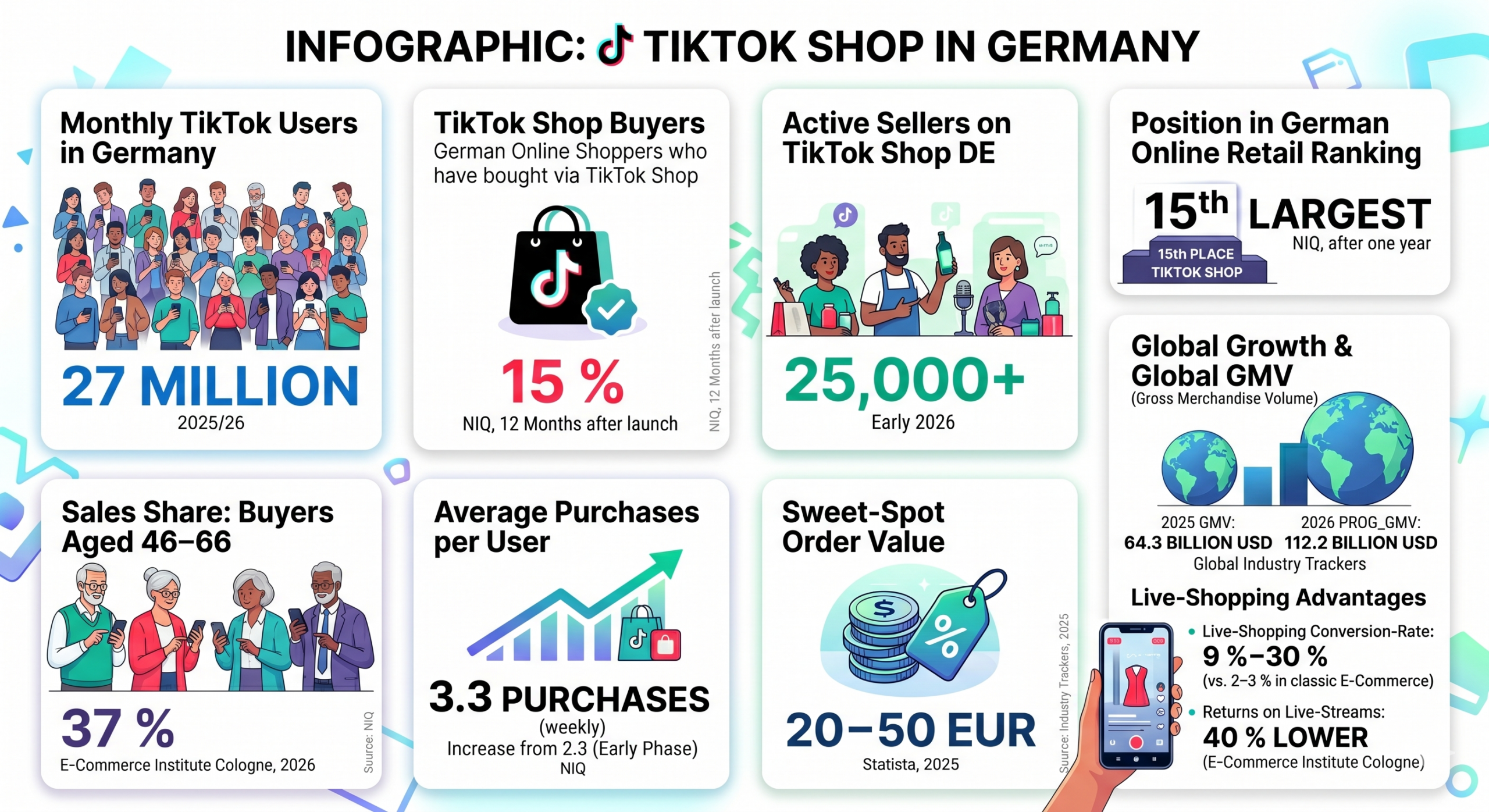
Two findings deserve special attention. First, TikTok Shop is not a Gen-Z-only channel: more than a third of revenue in Germany comes from the 46–66 age bracket — the demographic with the highest disposable income. Second, live-stream purchases convert at rates that traditional online shops can only dream of, and customers who buy in this format are far less likely to return their order. For sellers who can produce regular, well-paced content, the unit economics are structurally better than on most other marketplaces.
Two use cases that show the opportunity
Use case 1: An established brand opens a new sales channel
When TikTok Shop launched in Germany, brands such as Nivea or About You were among the first to sign up. Since then, international corporations like PepsiCo and several other brands have started actively testing the format. For these companies, TikTok Shop is not a replacement for their traditional channels but it is a way to reach the German consumer earlier in the buying journey, often at the moment of discovery rather than at the moment of intent.
The lesson for small and medium-sized businesses: you do not need a viral hit to benefit. A consistent presence with native German content, reliable fulfilment from inside Germany and a properly registered local entity will already put you ahead of most cross-border competitors.
Use case 2: A creator-led brand from scratch
The second use case is the small operator who builds a brand around content. Here, the numbers are striking: creators with up to 50,000 followers achieve average engagement rates of around 30 % on affiliate links which is over fifteen times higher than comparable Instagram creators. In the first half of 2025 alone, 291 individual influencers globally generated more than one million USD in TikTok Shop GMV.
For German creators or international entrepreneurs who want to build a brand in Germany, the entry barrier is low if the legal setup is right. A UG can be incorporated with as little as 300-500 EUR in symbolic share capital, giving solo founders a legitimate German limited company without the larger commitment of a GmbH.
Why TikTok Shop requires a German company
TikTok’s seller policies are the result of European law as much as of internal compliance choices. The platform must verify every commercial seller under several overlapping regulations, and the cleanest way to satisfy all of them is for sellers to operate through a properly registered local entity. There are five reasons this matters in Germany:
- KYC and anti-money-laundering rules. TikTok must identify every Ultimate Beneficial Owner (UBO) holding 25 % or more of the company. A German. In Germany, companies are required to file their list of shareholders with the Commercial Register, and they must also ensure that the Transparency Register always contains up-to-date information on all ultimate beneficial owners.
- VAT compliance. Sellers shipping from German fulfilment centres or storing inventory in Germany need a German VAT number (in German: Umsatzsteuer-Identifikationsnummer (USt-ID)), which TikTok validates against the Federal Tax Office’s records during onboarding.
- The EU Digital Services Act (DSA). Marketplaces must perform “trader verification” on every seller and publish a clear Site Notice (in German: Impressum) with the trader’s legal name, registered address and registration number.
- Returns and customer service. Under EU consumer law, buyers have a 14-day right of return. TikTok requires sellers to provide a German return address and customer-service contact in German.
- Banking and payouts. Payouts must go to an EU bank account which is owned by the German company.
A locally registered GmbH or UG ticks all five boxes in one move. It has a Commercial Register Extract, a Transparency Register Extract, a VAT number and satisfies the DSA’s trader-disclosure obligations and gives you the legal vehicle to open a German business bank account.
Are you considering to set up a company in Germany for your TikTok Shop?
Forming a German GmbH or UG with the right share capital, bank account and tax registrations does not have to be a six-month bureaucratic project. With the Premium All-In-One Service from GmbH-UG.com you can sign anywhere in the world and we handle the rest. If you need to start selling within days, our ready-made companies come pre-incorporated, debt-free and immediately operational.
GmbH or UG – your two main routes
For TikTok Shop sellers, the two practical legal forms in Germany are the GmbH (Gesellschaft mit beschränkter Haftung) and the UG (Unternehmergesellschaft haftungsbeschränkt). Both are limited liability companies which means the personal assets of the shareholders are protected; and both produce the documentation TikTok needs.
The headline differences are share capital and perception:
- A GmbH requires 25,000 EUR in share capital, of which 12,500 EUR must be paid in before incorporation. It is the gold standard for serious commercial activity in Germany and signals stability to suppliers, banks and platforms.
- A UG can be incorporated officially with as little as 1 EUR in symbolic share capital (we usually recommend at least 300–500 EUR for practical reasons). It is often called a “Mini-GmbH” and is the natural choice for solo founders, creators or pilot projects.
We compare the two in detail in our follow-up post: GmbH or UG for TikTok Shop? Choosing the right limited company.
How long does it take to set up a company and a TikTok Shop in Germany?
The classic incorporation process for a new GmbH or UG takes around 1 to 3 months in Germany, depending on city, notary availability and the time needed to obtain a tax number, VAT number and EORI number. We have explained the four steps in detail on our company formation page.
If you cannot wait that long, buying a ready-made (shelf) company shortens the process to as little as 1-2 weeks. A ready-made GmbH or UG is a clean, debt-free company that we have already incorporated and that comes with a bank account and registration numbers ready to be transferred to you. The cost is higher, but for sellers chasing seasonal demand the trade-off is often worthwhile.
| Route | Typical timeline | Best suited for |
| New GmbH or UG formation | 1-3 months | Planned launches, no urgent deadline |
| Shelf GmbH or UG | 1-2 weeks | Time-critical entries into TikTok Shop |
Your next steps
If TikTok Shop Germany is on your roadmap for 2026, the cleanest path is the following:
- Schedule a free initial consultation with a German company formation expert from GmbH-UG.com
- Form the company (or buy a ready-made one) and obtain your tax number, VAT number and bank account.
- Register on TikTok Shop Germany via the Seller Center using your German Commercial Register Extract (in German: “Handelsregisterauszug”).
- Set up your fulfilment, returns and DSA-compliance.
- Plan your ongoing compliance obligations.
Frequently Asked Questions Regarding TikTok Shop Opening in Germany
TikTok Shop Germany requires a locally registered business with a German VAT number, a German return address and an EU bank account in the company’s name. A German GmbH or UG is the cleanest way to meet all of these requirements at once. Source: TikTok, May 2026
EU-based companies can sell cross-border into Germany under certain conditions, but they often run into VAT thresholds, fulfilment limitations and reduced algorithmic visibility. Non-EU companies generally need a German subsidiary. For a smooth long-term setup, a German GmbH or UG is the recommended structure.
Both are limited liability companies and both are accepted by TikTok. A GmbH is preferred for higher-volume sellers and brands that want to project stability, while a UG is the natural choice for founders who want to start with minimal share capital and grow into a GmbH later.
After only one year on the market, TikTok Shop is already the 15th largest online retailer in Germany according to NIQ. Around 15 % of all German online shoppers have bought through the platform at least once, and over 25,000 sellers are now active on it.
A new incorporation takes around 1 to 3 months. If you need to start selling immediately, a ready-made GmbH or UG can be transferred to you within 1-2 weeks (or 48 hours, if you’ve already prepared everything yourself and scheduled a notary appointment).