Setting up a German Company from the UK: The 2026 Guide for British Founders
Since Brexit, a British company is a third country in the eyes of the German authorities. That single change is why so many UK founders now open a German GmbH or UG: not for tax reasons, but to keep an address, a VAT number and a bank account inside the European Union. This guide covers the four routes into the German market, the documents Companies House issues that a German notary will ask for, whether you have to fly to Germany, how to move share capital from a sterling account, and what a British-owned company really pays in Germany in 2026.
Why British founders expand into Germany
Germany is the fourth largest economy in the world and, for most British companies, it is the largest single market they lost frictionless access to in 2021. Selling into the EU from the UK now means customs declarations, an EORI number on the European side, import VAT, and, for anyone selling to consumers, a VAT registration in at least one member state. A German entity resolves all of that at once, and it does so in the market with the highest purchasing power in the Union.
There is a second, quieter reason. German customers, distributors and public-sector buyers still prefer to contract with a German company. An invoice from a GmbH removes a conversation that an invoice from a UK Ltd. starts.
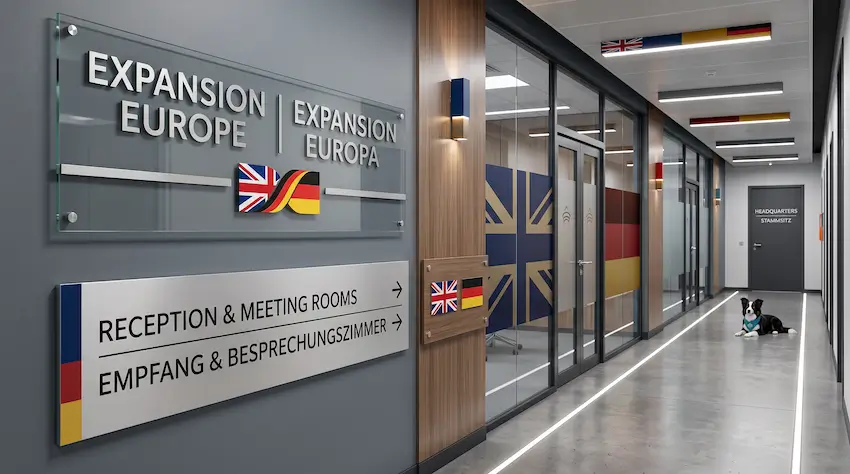
Your four routes into the German market
A British company has the same four options as any other foreign company, and we have set them out in detail in our article on 4 ways to register a foreign company in Germany. In short:
| Route | What it is | Suits a UK founder when |
|---|---|---|
| VAT registration only | A German tax number for a UK company, no German entity | You only ship goods to German customers and want nothing more |
| Dependent branch(unselbstständige Niederlassung) | An outpost of the UK company; invoices are issued in the UK company’s name | You need a presence, not a business; rarely a good fit post-Brexit |
| Independent branch(selbstständige Niederlassung) | Legally part of the UK Ltd. but trading in its own right | You want a German trading presence without a second company; but you will need tax advisers who understand both systems |
| Subsidiary: a GmbH or UG | A legally independent German company owned by you or by your UK Ltd. | You want a genuinely German company, an EU bank account, and an accountant who never needs to open a UK tax textbook |
Our recommendation for British founders is the subsidiary. The dependent branch is close to unusable in practice, because German banks generally will not open a business account for one and post-Brexit a UK Ltd. is now the parent of a third-country branch, which multiplies the paperwork rather than reducing it. A GmbH or UG costs more at the start and pays that back within the first year in banking, credibility and simplicity.
GmbH or UG: which fits a British founder?
Both are limited liability companies. The difference is capital and perception.
| GmbH | UG | |
|---|---|---|
| Minimum share capital | 25,000 EUR (12,500 EUR payable at formation) | 1 EUR; we recommend 500 EUR in practice |
| Notary fee, model protocol | from 350 EUR | from 180 EUR |
| Notary fee, standard articles | from 750 EUR | from 600 EUR |
| Commercial register | 300 EUR | 300 EUR |
| Reserve obligation | None | 25% of annual profit must be retained until the UG is converted into a GmbH |
| How German counterparties read it | An established company | A very small company where the founders had not so much money |
The UG is often called the mini-GmbH, and it is the right answer if capital is genuinely the constraint. But note the trade-off that matters specifically to British founders: if your German entity exists to look German to German buyers, a UG works against that goal. Where the UK parent can fund it, we usually advise the GmbH.
More detail in our guides to GmbH formation and UG formation, and you can compare the full setup fees in company registration fees in Germany.
The documents the UK issues that Germany asks for
This is where British applications stall, and it is entirely avoidable.

If the shareholder is a natural person
You will need a valid passport and proof of address. A German notary will normally want the passport certified, and for a British shareholder that certification is typically done by a UK notary public; not a solicitor’s copy and not a Post Office check.
If the shareholder is a UK limited company
Since Brexit, a UK Ltd. is a third-country legal entity, and the notary has to satisfy himself that it exists and that the person signing may sign for it. You will need:
-
A Certificate of Incorporation from Companies House
-
A current Certificate of Good Standing if the company is older than 6 months. Companies House issues this; the printed WebFiling summary is not a substitute
-
Proof of representation: confirmation that the named director is authorised to sign in the name of the company. In the UK this is issued by a notary public, which is the point most founders are unprepared for, because the UK has no equivalent of the German commercial register extract that would prove it automatically
Apostille and certified translation
The UK is a party to the Hague Apostille Convention, so the documents are apostilled by the Foreign, Commonwealth & Development Office (FCDO) Legalisation Office rather than legalised at an embassy. Standard service currently runs to a few working days; the premium service is faster.
Everything then needs a certified German translation by a sworn translator. Budget for both the apostille and the translation from the start. In our experience this is the largest single source of delay in British formations, and it is a scheduling problem, not a legal one.
As German company law and Commercial Register requirements can be unfamiliar to many UK notaries, we at GmbH-UG.com have developed our own templates to ensure the necessary documents meet German requirements.
We use these templates regularly to support our hundreds of UK clients.
Do you have to fly to Germany?
No, and this is the question we are asked most often by British clients.
German company formation is done in front of a notary, not a solicitor or a lawyer. The deed must be notarised. There are three ways a British founder handles that:
-
Attend in person. A day trip from London is realistic. Fastest option, and the one we recommend if the time is a very important factor.
-
Online notarisation (Online-Beurkundung). Germany has permitted video notarisation for certain formations since 2022. It is genuinely useful, but the requirements around identification documents are strict and not every case qualifies. Strictly speaking, this only works if all people involved have a new German identity card or residence permit issued after 2021.
-
Power of attorney. You sign a notarised, apostilled power of attorney in the UK and we handle the appointment in Germany on your behalf. For most British clients this is the practical way, and it is how we work with founders who cannot travel.
Moving share capital from a sterling account
The share capital must be paid into a German business bank account in EUR, and the bank must be able to evidence it. Two things regularly catch British founders out.
First, the account has to exist before the capital can be paid in, and German banks apply enhanced due diligence to non-resident directors. A UK passport is not a problem, but a UK address plus a UK parent company means more questions, not fewer. Allow real time for this.
Second, the exchange rate matters at the moment of deposit, not the moment of transfer. If you are forming a GmbH and transfer exactly 12,500 EUR worth of sterling, a movement in the rate between transfer and credit can leave you a few euros short of the statutory minimum and the registration will be rejected. Send a buffer or use payment providers like Wise.
Residence, visas and the managing director question
Owning a German company and living in Germany are two entirely separate questions, and Brexit changed only the second one.
-
Owning shares in a GmbH or UG: no residence permit, no visa, no minimum shareholding by a German resident. A British citizen resident in London can own 100% of a GmbH.
-
Being the managing director (Geschäftsführer): also possible from the UK. There is no legal requirement for the managing director to live in Germany. What is required is that you can actually discharge the duties: signing filings, dealing with the tax authorities and being reachable.
-
Living and working in Germany: here Brexit bites. Since 1 January 2021 British citizens are third-country nationals and need a residence title. If your plan is to relocate, that is a separate application and a separate timeline from the company formation.
The honest warning: if you are the sole director and you manage the company entirely from the UK, HMRC and the German Tax Authority (Finanzamt) can each take a view on where the company is effectively managed. For a genuine German operating subsidiary with German activity this is rarely an issue; for a shell that exists only on paper, it can be. Have it reviewed.
However, with sound and forward-looking planning, this can also bring advantages. For example, we have a manufacturer of household electronics that is very well known in the UK, which set up a German GmbH with us at the end of 2020. From the outset, they structured the company in such a way that it is not only fully recognised by the authorities but has also been granted full exemption from trade tax in Germany.
Tax: what changes because you are British
German taxes do not depend on your nationality. What depends on your nationality is what happens to the money when it leaves Germany.
In Germany, a GmbH or UG pays:
-
Corporate tax (Körperschaftssteuer) of 15%, plus the solidarity surcharge of 5.5% of that, which are together effective 15.825%
-
Trade tax (Gewerbesteuer), set by the municipality, typically in the 7–18% range. Your registered address therefore changes your tax bill; Munich, Frankfurt and Berlin are not equivalent
-
VAT at 19% standard, 7% reduced
See our corporate tax rate guide and the tax calculator for the arithmetic.
Between Germany and the UK, the double taxation agreement continues to apply. It is a bilateral treaty and was not affected by Brexit. What Brexit did remove is the EU Parent-Subsidiary Directive, which previously allowed dividends from a German subsidiary to an EU parent to flow without withholding tax. A UK parent now falls back on the treaty rate rather than the directive.

German withholding tax on dividends to a UK parent company
In 2026, a German subsidiary that pays a dividend to its UK parent company must normally deduct German withholding tax. Under the double tax treaty between the UK and Germany (Article 10(2)(a)), the rate can be cut to 5%. Two conditions apply: the UK company must be the real (beneficial) owner of the dividend, and it must hold at least 10% of the German company’s capital directly. Please note: 5% is the final treaty rate. It is not always the amount taken off at the start.
What changed after Brexit
Before 2021, many UK parent companies paid no German withholding tax at all, thanks to the EU Parent–Subsidiary Directive. Since 1 January 2021, this EU rule no longer applies to UK companies. For such a group, the rate has gone up from 0% to 5%. In practice, this means 5,000 EUR of German tax for every 100,000 EUR paid out. This is a clear extra cost caused by Brexit, although UK tax relief may reduce the overall burden.
Full tax first, refund later
If the UK parent does not hold a valid exemption certificate in advance, Germany usually deducts the full rate of 26.375% (this includes the solidarity surcharge). The UK company then has to ask the Federal Central Tax Office (Bundeszentralamt für Steuern, BZSt) to pay back the extra tax under section 50c(3) of the German Income Tax Act (EStG).
A simple example with a dividend of 100,000 EUR:
-
Tax deducted at first: 26,375 EUR
-
Amount you can claim back: 21,375 EUR
-
German tax you finally pay: 5,000 EUR
How to claim the refund
The claim must be made online through the BZSt portal. You need two documents: a certificate showing that the company is tax resident in the UK, and the German certificate confirming the tax that was deducted. You normally have four years from the end of the year in which you received the dividend. For a dividend received in 2026, the deadline is 31 December 2030.
Be prepared to wait. The BZSt says that a refund can take more than 20 months. So the company not only pays an ongoing tax cost, but also has money tied up for a long time. Finally, the lower treaty rate is not automatic just because the shareholder is a UK company. The company must meet all conditions, including German anti-abuse rules.
Costs and timeline for a British founder
| Step | Typical cost | Typical time |
|---|---|---|
| UK documents (Companies House, notary public, FCDO apostille) | 400-800 GBP | 1–2 weeks |
| Certified German translation | 100-300 EUR | 3–5 days |
| Notarisation of the formation deed | from 350 EUR (GmbH, model protocol) | 1 day |
| Business bank account and capital deposit | 0 EUR | 0–3 weeks |
| Commercial Register entry | 300 EUR | 2–6 weeks |
| Trade registration in the city | 15–60 EUR | 0-3 weeks |
| Tax number, VAT number, EORI number | 0 EUR | 2–8 weeks |
Realistic end to end: six to twelve weeks from first document to a fully operational German company. If that is too slow, a ready-made (shelf) company is already entered in the commercial register and can be trading in days.
Common mistakes we see with British clients
-
Assuming a solicitor can do what a German notary does. They cannot; the deed must be notarised.
-
Bringing a Companies House printout instead of an apostilled Certificate of Incorporation, and losing two weeks to it.
-
Having documents certified by a notary in the UK without the notary having recorded the signatory’s full name, date of birth and address in their endorsement. This results in double notary, apostille and translation fees.
-
Registering the company at whatever address is convenient, without checking whether the business address meets the regulatory requirements.
-
Treating the German company as a UK company with a German name: missing the monthly VAT declarations, the annual accounts deadline, or the Transparency Register entry. See our guide to the running costs and obligations of a German company.
Our recommendation
For most British founders expanding into Germany, a GmbH subsidiary, formed by power of attorney, with a properly prepared set of apostilled Companies House documents, is the right route. It gives you an EU entity, a German bank account, German VAT & EORI numbers and a German invoice and it keeps your accountant’s work inside one tax system.
The formation itself is not difficult. What makes British formations slow is the document chain: Companies House, notary public, FCDO, sworn translator, each with its own queue. Start that chain first and the rest follows.
We, at GmbH-UG.com, handle company formation in Germany for UK founders from abroad, including the power of attorney, so you never have to schedule a trip around a notary’s diary. Get in touch and we will tell you exactly which documents your case needs.
Frequently asked questions
Can a UK resident own a German GmbH?
Yes. There is no residence or nationality requirement to hold shares in a GmbH or UG. A British citizen living in the UK can own 100% of a German company, and a UK limited company can be the sole shareholder.
Do I need to travel to Germany to form the company?
Not necessarily. The formation deed must be notarised in Germany, but you can grant a notarised and apostilled power of attorney in the UK and have it handled on your behalf. Online notarisation is only possible for German passport or residency holders.
Is a UK company still an EU company for German purposes?
No. Since 1 January 2021 a UK limited company is a third-country entity. This affects the documents a German notary requires and removes the EU Parent-Subsidiary Directive benefit on dividends.
How much share capital do I actually need?
A GmbH requires 25,000 EUR, of which 12,500 EUR must be paid in at formation. A UG legally requires 1 EUR, but we recommend 500 EUR so the company can cover its own first costs.
Do I need a German-resident managing director?
No. The managing director may live abroad, including in the UK. You must be able to perform the role in practice, and if you intend to relocate to Germany you will need a residence title separately.
How long does it take from the UK?
Typically six to twelve weeks end to end, with the UK document chain and the bank account being the two slow steps. A ready-made company shortens this to days.

Disclaimer: The content of these blog articles has been prepared with the utmost care. However, we cannot guarantee the accuracy, completeness, correctness, quality, or timeliness of the content. Any claims against the author for damages caused by the use of the information provided are generally excluded. The articles do not replace legal and/or tax advice.