E-invoicing in Germany from 1 January 2027: what a foreign-owned GmbH must do now
The timeline at a glance
| Date | What applies | Who |
| Since 1 January 2025 | Must be able to receive structured e-invoices | Every business established in Germany, incl. every GmbH and UG |
| 1 January 2027 | Must issue e-invoices for domestic B2B sales | Businesses with prior-year (2026) turnover above 800,000 EUR |
| 1 January 2027 – 31 December 2027 | May still send paper or PDF invoices with the customer’s consent | Businesses with 2026 turnover of 800,000 EUR or less |
| 1 January 2028 | Must issue e-invoices for domestic B2B sales | All businesses (except small businesses under § 19 UStG) |
Source: Growth Opportunities Act (Wachstumschancengesetz) 2024, § 14 and § 27(38) German VAT Act (UStG)
The 800,000 EUR threshold refers to the issuer’s total turnover in the previous calendar year. A GmbH founded in 2026 with a small turnover therefore has until 1 January 2028 to issue e-invoices, but must be able to receive them from day one. If you are still planning your company formation in Germany, build e-invoicing into your bookkeeping set-up from the start.
What counts as an e-invoice?
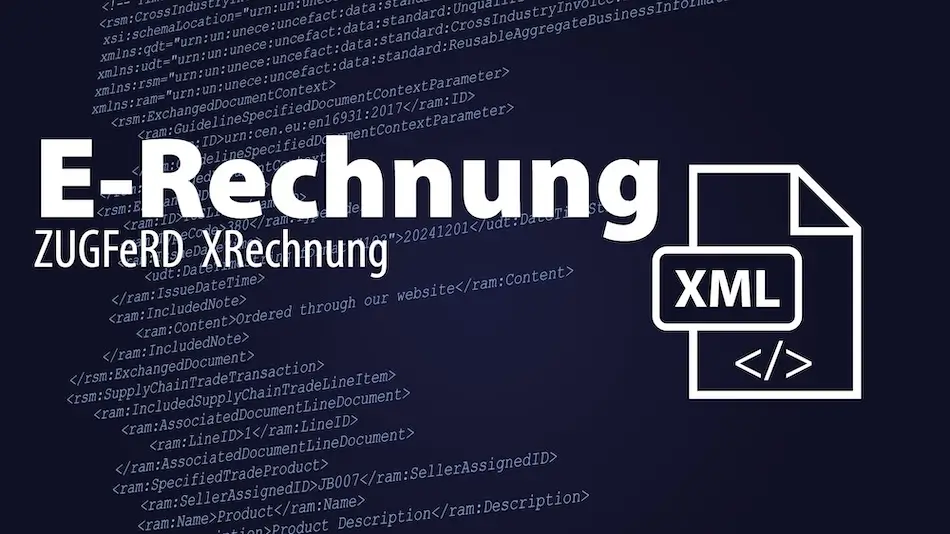
An e-invoice (E-Rechnung) is not a PDF. It is a structured data file that complies with the European standard EN 16931, so that the recipient’s software can read it automatically. In Germany, two formats dominate:
-
XRechnung: a pure XML file. Mandatory for invoices to German public authorities, also usable between businesses.
-
ZUGFeRD (from version 2.0.1, excluding the MINIMUM and BASIC-WL profiles): a hybrid format, a PDF with embedded XML data, readable by people and software.
A PDF sent by email, a scanned paper invoice or a Word document is now an “other invoice” (sonstige Rechnung) and is only allowed during the transition period.
What a German GmbH must do, by stage
Receiving (already mandatory): the company needs an email address or portal where suppliers can send XML files, and software that can display, check and archive them. Archiving must be in the original format for eight years under the German Fiscal Code.
Issuing (from 2027 or 2028): the company’s invoicing or accounting software must create EN 16931 invoices. Most German accounting software (DATEV, GetMika, lexoffice, sevDesk and others) already does. If your group invoices from an international ERP system, check now whether it can produce XRechnung or ZUGFeRD for the German entity.
Good to know: a supplier does not need your consent to send you a compliant e-invoice. If your German company still asks for PDFs in 2026, it will soon start receiving XML files it cannot open, and an invoice you cannot read is still an invoice you must pay and book.
The foreign-owned GmbH: what most guides miss
The mandate covers domestic B2B sales: both the supplier and the customer are established in Germany. That has three practical consequences for international groups:
| Invoice | E-invoice mandatory? | Why |
| German GmbH → German business customer | Yes (2027 or 2028) | Domestic B2B supply |
| German GmbH → its parent company abroad (e.g. UK Ltd, US Inc.) | No | Recipient not established in Germany |
| Parent company abroad → German GmbH | No, unless the parent has a German establishment involved in the supply | Supplier not established in Germany |
| German GmbH → consumers (B2C) | No | B2C is outside the mandate |
| German GmbH → EU business customer (intra-Community supply) | No (not before ViDA, from 2030) | Cross-border supply |
Downside: “outside the mandate” does not mean “no rules”. Cross-border invoices still need every mandatory VAT detail, including the reverse-charge note, and the German GmbH must still archive them properly. And if the parent is registered for VAT in Germany through a fixed establishment, its invoices to German customers may fall within the mandate. Have your tax adviser check the group’s invoice flows once.
Exceptions
The following do not require an e-invoice, even after 2028:
-
invoices up to 250 EUR gross (small-value invoices, § 33 UStDV)
-
tickets for passenger transport
-
most VAT-exempt supplies, e.g. many financial and insurance services
-
invoices from small businesses under § 19 UStG (they must still be able to receive e-invoices)
What it costs
For most small companies, e-invoicing is already included in the accounting software they use, or costs up to around 300 EUR a year as a standalone tool (2026). The real cost is the one-off setup: connecting the invoicing system, testing with the largest customers, and changing how incoming invoices are approved. We include the costs in our overview of the annual running costs of a German company.
A checklist for the next eight weeks
-
Check your company’s 2026 turnover: above or below 800,000 EUR?
-
Confirm that your company can receive and archive XRechnung and ZUGFeRD today.
-
Ask your accounting software provider whether it can issue EN 16931 invoices.
-
List your German business customers and agree the receiving channel (email, portal, etc.).
-
Map your intercompany invoices and confirm with your tax adviser which are in scope.
-
Send a test e-invoice to one customer before 1 January 2027.
E-invoicing needn’t be a project
For most GmbHs, e-invoicing is a software setting, not a transformation. The risk lies in assuming it doesn’t apply because the company is foreign-owned. Our English-language bookkeeping in Germany service receives, checks and archives e-invoices for your GmbH and sets up compliant outgoing invoices. Book a 15-minute call to check where your company stands.
FAQ
When does e-invoicing become mandatory in Germany?
Every business in Germany must be able to receive e-invoices since 1 January 2025. Issuing them for domestic B2B sales becomes mandatory on 1 January 2027 for businesses with a prior-year turnover above 800,000 EUR, and on 1 January 2028 for all businesses.
Does e-invoicing apply to a newly founded GmbH?
Yes. A new GmbH or UG must be able to receive structured e-invoices from its first day. It must issue them for domestic B2B sales from 1 January 2028 at the latest, or from 2027 if its turnover in 2026 exceeded 800,000 EUR.
Is a PDF invoice an e-invoice?
No. Under German law, an e-invoice is a structured file conforming to EN 16931, such as XRechnung or ZUGFeRD. A PDF is an “other invoice”, which may still be used for domestic B2B sales only during the transition period and with the customer’s consent.
Does my German GmbH have to send e-invoices to its parent company abroad?
No. The mandate only covers supplies between businesses established in Germany. Invoices from a German GmbH to a parent company abroad are outside its scope, but must still include every mandatory VAT detail, such as the reverse-charge note where it applies.
What formats are accepted for e-invoices in Germany?
Formats that comply with EN 16931: chiefly XRechnung (XML) and ZUGFeRD from version 2.0.1, excluding its MINIMUM and BASIC-WL profiles. Other formats, such as certain EDI procedures, are allowed if the required data can be extracted in line with the standard.
What happens if a German company doesn’t issue e-invoices from 2027?
An invoice in the wrong format does not meet the legal requirements. Your customer may then be unable to deduct input VAT and refuse payment until you issue a correct invoice, and the tax office can treat it as a breach of invoicing rules.

Disclaimer: The content of these blog articles has been prepared with the utmost care. However, we cannot guarantee the accuracy, completeness, correctness, quality, or timeliness of the content. Any claims against the author for damages caused by the use of the information provided are generally excluded. The articles do not replace legal and/or tax advice.