LLC Subsidiary in Germany: The Complete Guide for US Business Owners (2026)
1. Why US LLC owners use a German subsidiary instead of expanding the LLC directly
A US LLC cannot be entered in the German Commercial Register as an operating German business. It can sell into Germany cross-border, but the moment the activity becomes substantial, local staff, a German warehouse, German VAT obligations, B2B contracts with German enterprises, an Amazon DE seller account with EU fulfillment, three things start to break:
- Permanent establishment exposure: German tax authorities can assert that the LLC has a Betriebsstätte (permanent establishment) in Germany, triggering German corporate tax on the attributed profits even without a legal entity.
- B2B credibility: German enterprises, banks, landlords, suppliers, and marketplace platforms (Amazon.de, OTTO, Zalando, Kaufland, TikTok Shop) expect a German legal entity with a Handelsregister-Nummer and USt-IdNr. (EU VAT ID). A foreign LLC is treated as a higher-friction counterparty.
- VAT, EORI, OSS: Selling physical goods to German consumers above the EU distance-selling threshold of €10,000 forces VAT registration anyway; a German GmbH solves this cleanly and lets the entire EU be served from one VAT number via the One-Stop-Shop (OSS) scheme.
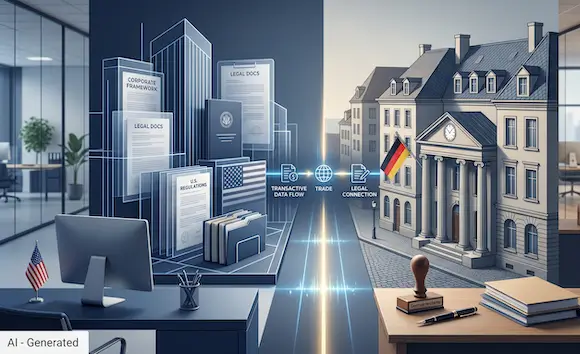
The standard solution is a two-tier US–German structure:
Structure
US LLC
Parent company
100% shareholder
German GmbH or UG
Operating subsidiary
The LLC keeps its US tax identity. The GmbH operates in Germany under German corporate, employment, and VAT law. Profits flow up as dividends under the US-Germany tax treaty.
2. The two most common legal forms a US LLC can use for its German subsidiary
A German subsidiary is mostly one of two limited-liability forms. The decision is purely commercial. Both protect the US parent identically.
GmbH (Gesellschaft mit beschränkter Haftung)
| Item | Value |
|---|---|
| Minimum share capital | 25,000 EUR (12,500 EUR paid in during the company formation) |
| Liability of US LLC parent | Limited to its capital contribution |
| Credibility with German banks, suppliers, B2B clients | High, preferred for serious operations |
| Typical US use case | US LLC operating a real product, service, sales team, or warehouse in Germany |
| Time to incorporate from scratch | about 4–8 weeks |
| Time to acquire a shelf GmbH | about 1 week |

UG (haftungsbeschränkt) — “Mini-GmbH”
| Item | Value |
|---|---|
| Minimum share capital | 1 EUR (in practice at least 500 EUR recommended) |
| Liability of US LLC parent | Limited to its capital contribution |
| Mandatory reserve | 25% of annual profit until the UG is converted into a GmbH company |
| Typical US use case | Lean market entry, US service LLCs testing EU demand, US consultants with a German billing entity |
| Time to incorporate from scratch | about 4–8 weeks |
| Time to acquire a shelf UG | about 1 week |
Decision rule for US LLC owners: If German banking, B2B contracts, marketplace seller-central accounts, or a German employer-of-record relationship matter from day one – choose GmbH. If you are testing the market with a small budget and accept slower bank onboarding – choose UG. Both can be 100% owned by your US LLC.
3. The Check-the-Box question and why most US LLC owners get this wrong
This is the single most misunderstood topic in the US-to-Germany LLC structure, and it is the reason a German tax adviser conversation before incorporation pays for itself many times over.
What the German side does automatically
A GmbH is a “per-se corporation” under US tax rules. It appears on the IRS list of foreign entities that cannot make a Check-the-Box election (IRS Form 8832 regulations). A German GmbH will therefore always be treated as a C-corporation by the IRS. There is no flow-through option for the GmbH itself.
What the US side does on the LLC
Your US LLC, on the other hand, is an “eligible entity” and can elect its own classification on Form 8832:
- Single-member LLC → default: disregarded entity (income flows to the owner)
- Multi-member LLC → default: partnership
- Either → elected: C-corporation
Why this matters for the US-Germany structure
The combination of these two facts produces three realistic structures, and each has different treaty consequences:
| Structure | US LLC Tax Status | German GmbH Tax Status | Dividend WHT under Treaty | Note |
|---|---|---|---|---|
| A: Default LLC + GmbH | Disregarded / partnership | C-corp (per-se) | Often 15% (portfolio rate) | Risk of losing the 5% direct-investment rate; requires careful LOB and Article 1(7) analysis |
| B: LLC elects C-corp + GmbH | C-corporation | C-corp | 5% (≥10% voting ownership, LOB test met) | Most common structure for serious operations |
| C: US C-Corp parent + GmbH | C-corp | C-corp | 5% (or 0% at 80%+ direct ownership meeting LOB) | Often preferred where the US parent is already a Delaware C-Corp |
The practical takeaway for a US LLC owner is simple: do not skip the Form 8832 conversation. Filing the wrong default classification (or no election at all) can cost you 10 percentage points of withholding tax on every euro of dividend you ever extract from Germany.
Form 8832 has a strict deadline: for new structures, the election must generally be filed within 75 days of the effective date. GmbH-UG.com routinely connects US clients to German tax advisers and US CPAs who handle this exact cross-border election together.

4. The full setup process: Step by step for a US LLC parent
Step 1: The Decision: new incorporation or shelf company
A shelf company is a fully formed GmbH or UG that has never traded, with paid-in share capital, an active Commercial Register entry, and an existing German bank account. For US LLC owners the shelf route is usually preferred because:
- The entity is operational within about 1 week hours vs. 4–8 weeks for a new incorporation
- The chicken-and-egg banking problem (you need a bank account to pay in capital, but the bank wants to see a registered entity) is already solved. The account exists with the 25,000 EUR capital in it
- The notary, register, and tax steps for transferring shares to the US LLC parent are dramatically shorter
- The registered office, business name, and corporate purpose can be amended after transfer
Step 2: Notarisation, with a US LLC as shareholder
German company formation requires a notary. With a US LLC as the shareholder, the LLC’s authorised signatory has three workflows:
- Travel to Germany: usually combined with a market-entry trip; one-day appointment.
- Notary in the US + Apostille: sign the share-purchase or formation documents in front of a US notary public, then obtain an Apostille from the US Secretary of State of the issuing state (Hague Apostille for Germany). Germany has accepted the Apostille since 1965; no embassy legalisation needed.
- Power of Attorney (Vollmacht): the US signatory issues an apostilled power of attorney to a German trustworthy company formation provider, like GmbH-UG.com who then executes the notarial steps in Germany. This is the fastest remote route and the standard at GmbH-UG.com.
Required corporate documents from the US LLC parent typically include:
- Articles of Association (apostilled) with certified Germany translation
- Certificate of Good Standing of the LLC (apostilled, often dated within 90 days) with certified Germany translation
- Operating Agreement (extract or full, depending on the notary) with certified Germany translation
- Signatory authority of the LLC manager or member (often via apostilled resolution) with certified Germany translation

Step 3: Business bank account for the GmbH
This is the single biggest practical pain point for US LLC owners. US persons trigger FATCA reporting at every German bank, which thins the list of willing institutions:
- Traditional German banks (Commerzbank, Sparkassen, Volksbanken) offer highest credibility, slowest onboarding, often require in-person identification; FATCA-readiness varies by branch
- Fintech / digital banks (Qonto, Finom, Holvi, Revolut Business) are faster, more flexible for non-resident directors, but acceptance of US-owned entities varies
Step 4: Commercial Register entry
Once notarised, the Commercial Register entry, and full legal capacity with limited liability, typically appears within 4-8 weeks for a new incorporation. A shelf company is already entered; only the share transfer, the new name, new activity and the new management are recorded.
Step 5: German tax registration
The local Tax Office, the Federal Central Tax Office and the Zoll issue:
- Steuernummer (tax number) within about 2–6 weeks
- USt-IdNr. (EU VAT identification number) within about 1–4 weeks after the tax number
- EORI number (for any import/export of goods) within about 1–3 weeks after the tax number

Step 6: Trade office registration (Gewerbeanmeldung)
Most operating GmbH and UG companies must register at the local Gewerbeamt. Purely capital-managing or specific regulated activities are exempt.
Step 7: Transparency Register (Transparenzregister)
The beneficial owners (UBOs) behind the US LLC must be reported to the German Transparency Register within statutory deadlines. Not just the LLC itself. This means the natural persons owning ≥25% of the LLC are disclosed.
5. The five US-specific pain points and how to solve them
Pain Point 1: FATCA, US-person status, and bank onboarding
German banks must report US-owned accounts under FATCA. The practical workaround: use a fintech business account (Finom, Wise, Revolut) for daily operations.
Pain Point 2: Form 8832 / Check-the-Box election timing
Most US LLC owners only learn about the 75-day deadline after they have already incorporated. The fix: align the German incorporation date and the LLC’s intended classification election before notarisation, working with a German tax adviser and a US CPA together.
Pain Point 3: Permanent establishment exposure for the US LLC
If the LLC owner continues to manage the German GmbH from the US, making strategic decisions, signing contracts, holding board calls, German tax authorities may argue the place of effective management of the GmbH is in Germany (fine) but also that the LLC itself has a German PE through the controlling shareholder. Mitigation: clear board-of-directors documentation, a German managing director (Geschäftsführer), board meetings held in Germany, and treaty-based PE analysis upfront.
Pain Point 4: VAT, EORI, OSS, and import compliance from day one
Any US LLC selling physical goods into Germany, whether via Amazon FBA, a direct shop, or a marketplace, needs a German VAT number, an EORI number, and usually an OSS registration. The GmbH solves this cleanly. Without a German entity, the LLC must register for VAT directly and appoint a fiscal representative for many supplies.
Pain Point 5: German-language administration
Notary deeds, Commercial Register filings, tax returns, and most authority communications are in German. English is workable for advisory conversations but not for filings. A full-service provider (notary handling, register, trade office, tax office, transparency register; tax, VAT and EORI applications) removes this entire workstream from the founder’s plate.

Five points US LLC owners should clarify in the USA before incorporation in Germany:
- Whether the LLC’s classification under Form 8832 will give it treaty access as a “company” (Structures B and C above) or only fiscal-transparency access
- Whether the Limitation on Benefits (LOB) article disqualifies the structure (active-business, ownership-and-base-erosion, derivative-benefits tests)
- Whether the US owner becomes German tax-resident under the 183-day rule or center-of-vital-interests test
- Whether the German entity creates a US PE through the US LLC’s activities
- The US savings clause under the treaty — US citizens and green-card holders still file a US return on worldwide income regardless of treaty results, with relief via Form 1116 and Form 8802 / Form 6166 certifications
7. Visa and residence: only if the US owner wants to move to Germany
You do not need to live in Germany to own or manage a German GmbH or UG. The German entity can have a US-resident shareholder, a US-resident managing director, and operate fully while the US owner remains in the US.
If you want to physically move to Germany to run the subsidiary, the standard route for US citizens is the self-employed residence permit under §21 AufenthG:
- Requires a credible business plan, financing proof, and evidence of economic interest for the region
- Decided case by case by the local Ausländerbehörde and the relevant German diplomatic mission
- For applicants aged 45 and over, retirement-provision evidence is also required
- US citizens can enter Germany visa-free for 90 days and apply for the permit from inside Germany at the local Ausländerbehörde – a practical advantage few other nationalities have
A second route worth knowing: if the GmbH employs the US owner under a regular employment contract, the EU Blue Card (for qualified employees meeting the salary threshold) can be faster and less discretionary than §21.
8. Costs at a glance
| Cost Item | Typical Range |
|---|---|
| New GmbH incorporation (notary, register, advice) | 2,500-3,500 EUR |
| Shelf GmbH (incl. 25,000 EUR paid-in capital and German bank account) | from 29,000 EUR |
| Shelf UG (incl. 500 EUR paid-in capital and German bank account) | from 3,500 EUR |
| Apostille per US document (varies by state) | about 8-50 USD per document |
| US notary public + Apostille handling (Articles of Organization, Certificate of Good Standing, Power of Attorney) | typically 200-600 USD total |
| Power-of-Attorney handling in Germany | included in the fee of GmbH-UG.com |
| Virtual office in Berlin, Munich, Düsseldorf, Frankfurt, Cologne, Hamburg, Nuremberg, Grünwald or Berching | from 185 EUR / month |
| German tax adviser (ongoing, small subsidiary) | about 150-250 EUR / hour |
| Form 8832 filing (US CPA) | about 300-1,500 USD |
9. The fastest path from US LLC to operating German subsidiary
For US LLC owners who want the shortest possible runway from decision to first German invoice, the combination is:
- Shelf GmbH or shelf UG: already registered, already capitalized, with a German bank account → operational in about 1 week
- Virtual office in a German city (Munich, Düsseldorf, Frankfurt, Cologne, Nuremberg, Berlin, Hamburg): registered office and business address suitable for the Commercial Register
- Power of Attorney route: US LLC manager signs once in front of a US notary, gets the Apostille, ships the package; everything in Germany is then handled by GmbH-UG.com
- Tax-adviser (both sides): German tax adviser + US CPA aligned on Form 8832 timing and treaty positioning
- Full A-to-Z service: Notary, Commercial Register, Trade Office, Tax Office, Transparency Register; as well as tax number, VAT number, EORI number applications
GmbH-UG.com (operated by Formatera Service GmbH) is built around this exact combination. The company has helped more than 1,000 entities across over 50 countries, with strong specialisation in cross-border US-German setups. Exactly the situation a US LLC owner faces.
FAQ: US LLC as Owner of a German GmbH
?
Can a US LLC own 100% of a German GmbH?
Yes. A US LLC can be the sole shareholder of a German GmbH or UG.
?
Do I need to dissolve my US LLC to open a German subsidiary?
No. The standard structure keeps the US LLC alive as the parent and adds the German GmbH or UG underneath it. Dissolution is only relevant if you are intentionally moving the entire business to Germany.
?
How long does it take a US LLC owner to get an operating German subsidiary?
A new incorporation takes 4–8 weeks from notary appointment to fully operational entity, including bank account, tax number, and EORI. A shelf GmbH or UG is operational in 1 week once apostilled documents and the Power of Attorney are in place.
?
Does a US LLC owner need to travel to Germany?
No. The full setup can be done remotely using a US notary + Apostille + Power of Attorney for a German specialist to execute the notarial steps. The US owner never has to be physically present in Germany.
?
Do I need a Check-the-Box election on Form 8832?
You should evaluate it. A US LLC that is a disregarded entity or partnership by default may not get clean treaty access for the 5% dividend rate; electing C-corporation status for the LLC is the most common solution for treaty-driven structures. The election must generally be filed within 75 days of the relevant effective date — so plan it before German incorporation, not after.
?
Can the GmbH have a US-resident managing director?
Legally yes. A managing director of a German GmbH or UG does not need to be a German or EU resident. Practically, German banks frequently require at least one EU-resident director for account opening, so many US LLC owners appoint a co-director.
?
What documents from the US LLC are needed for German notarisation?
Typically: Articles of Organization, Certificate of Good Standing, Operating Agreement (extract), and signatory authority for the manager/member, all apostilled by the issuing US state’s Secretary of State and with a certified German translation. Originals less than 90 days old are usually preferred by German authorities.
?
Is a German GmbH or UG better for a US LLC owner?
Choose GmbH if credibility with German banks, B2B customers, suppliers, marketplaces, employers-of-record. Choose UG if the priority is minimal capital and lean market entry, for example, a US service LLC testing EU demand. Both can be 100% owned by your US LLC and converted later and you can convert your UG into a GmbH later.
?
Does my US LLC need to register with the German Transparency Register?
The German subsidiary (GmbH/UG) must report the ultimate beneficial owners: the natural persons holding ≥25% of the US LLC to the German Transparency Register. The LLC itself is not the UBO; the people behind the LLC are.
?
What does GmbH-UG.com do that other providers do not?
GmbH-UG.com delivers the full A-to-Z US-to-Germany service: notary in Germany or via apostille + power of attorney from the US, business address in 9 German cities, communication with the authorities, tax-adviser introduction, all necessary applications.
10. Next step
If you are a US LLC owner considering a German subsidiary, book a free initial consultation with GmbH-UG.com. The first call covers your existing LLC structure, the right legal form (GmbH or UG), the right German city and the realistic timeline from signature to first invoice.
The content of these blog articles has been prepared with the utmost care. However, we cannot guarantee the accuracy, completeness, correctness, quality, or timeliness of the content. Any claims against the author for damages caused by the use of the information provided are generally excluded. The articles do not replace legal and/or tax advice.
About the Author

This blog post was written by Kristof Tomasz, Managing Director of GmbH-UG.com. Kristof is a serial entrepreneur and has been helping international companies successfully set up businesses in Germany since 2017.