In the start-up scene, UG Holdings for SMEs are currently all the rage. And with good reason: this company structure offers a number of interesting options for founders with limited start-up capital. Here we’ve listed everything you need to know before setting up a UG Holding.
What is a Holding anyway?
Anyone who establishes a holding structures their company into a parent company and at least one additional subsidiary. They are therefore establishing two companies, so to speak. The corporate purpose of the parent company is participation in other companies – for example, in their subsidiary/subsidiaries. Subsidiaries are considered independent companies and are completely autonomous before the law.
The holding is a corporate structure, not a separate legal form. Until 2008, German companies only had the option of establishing a GmbH to benefit from the tax advantages and limitation of liability of a holding. However, establishing a GmbH normally requires 25.000 EUR – although due to the corporate form, it is also possible to limit the active founding capital to 12.500 EUR.

Increasingly more German founders therefore relocated their company headquarters to Great Britain to benefit there from the tax advantages and the low founding capital for a Ltd. (Limited). The Federal Government therefore decided to develop a German alternative to the Ltd. With the Act on the Modernisation of GmbH Law and the Prevention of Abuses (MoMiG) of 23 October 2008, a “slimmed-down variant” of the GmbH was created for company founders in Germany: the Unternehmergesellschaft (haftungsbeschränkt).
What exactly is a UG (haftungsbeschränkt)?
According to information from the Federal Ministry for Economic Affairs and Energy, the UG (haftungsbeschränkt) – Unternehmergesellschaft – is a variant of the GmbH that is particularly suitable for founders of smaller commercial enterprises with limited start-up capital. It enables entrepreneurs to massively limit their liability so that they do not have to be liable with their own capital in the event of liability.
Establishing a UG Holding
Here is a brief overview of the most essential legal regulations for establishing a UG (haftungsbeschränkt):
-
- Share capital of at least 1 EUR
-
- At least 1 shareholder
-
- Establishment via notarised standard protocol
-
- Registration in the Commercial Register only with notarised standard protocol
-
- Naming of the company fundamentally free – including fantasy names
-
- Name suffix “UG (haftungsbeschränkt)” is mandatory
To save time when establishing, many choose a prefabricated holding structure that consists of one or more shelf companies.
Taxes and Accounting for a UG Holding
As a variant of the GmbH, the UG falls under the provisions of the HGB (Commercial Code). It is therefore obliged to maintain the usual statutory accounting. This means the preparation of double-entry bookkeeping and an annual balance sheet.
A UG is obliged to pay trade tax, corporation tax and solidarity surcharge – always in proportion to its net profits. The distribution of profits to shareholders is subject to capital gains tax.
That now sounds as if a UG would have to pay particularly high taxes. But exactly the opposite is the case. Due to the corporate structure, profits and losses can be shifted back and forth between parent and subsidiary companies. It is even possible to establish subsidiaries in countries with particularly low taxes, to which a substantial proportion of the UG’s profits is posted. The whole thing is legal and has been practised by well-known companies for decades.
Saving Obligation: A Special Feature of the UG Holding
Profits of the Unternehmergesellschaft (haftungsbeschränkt) may only be distributed to the extent of 75%. The remaining 25% flow into a statutory reserve until the UG is converted into a GmbH.
Establishing a UG Holding – These are the Costs involved
The costs for establishing a UG (haftungsbeschränkt) are comparatively low. With the lower limit of one euro for share capital, the legislator wants to motivate innovative start-ups to choose Germany as their company location. The same applies to the favourable taxation when selling a subsidiary to the parent company.
A UG Holding falls under GmbH law – which means that for one euro “entrance fee”, it enjoys the same advantages as a GmbH. In addition, unlike the GmbH, the UG (haftungsbeschränkt) can simply be entered in the Commercial Register with a certified standard protocol.
Below we have listed for you in bullet points approximately how high the costs for establishing a UG Holding are. Your actual costs – for example, the notary’s fees – may deviate slightly from this.
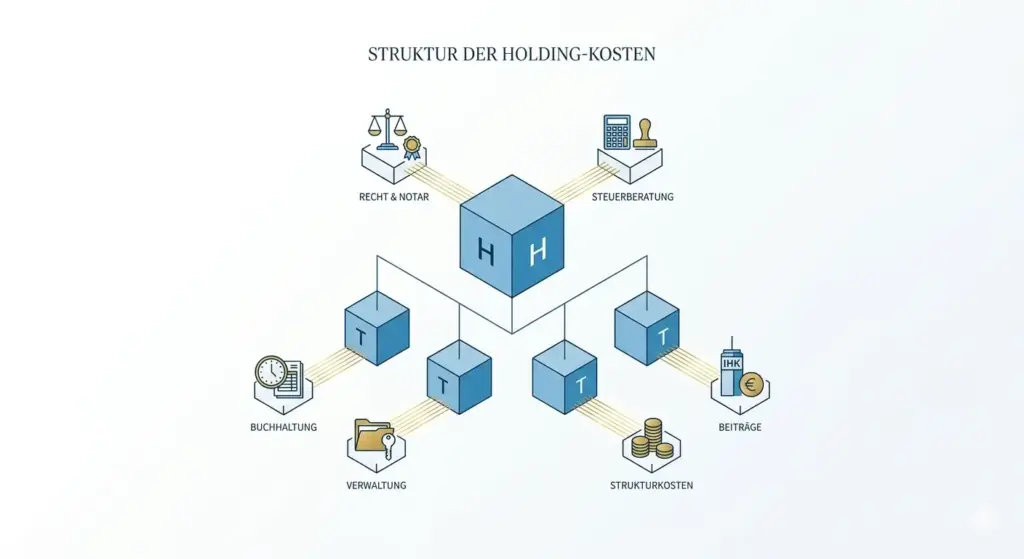
UG Holding Establishment Costs at a Glance
-
- Share capital: from 1 EUR (recommended: at least 300 EUR)
-
- Notary: from 250 EUR
-
- Entry in Commercial Register: 300 EUR (as of: June 2026)
| Cost Item | Amount | Note |
|---|---|---|
| Share capital | from 1 EUR | Recommended: min. 300 EUR |
| Notary | from 180 EUR | Variable depending on effort |
| Commercial Register entry | 300 EUR | As of: July 2026 |
Pros and Cons of a UG Holding
Obviously, there are numerous advantages that speak for establishing a UG (haftungsbeschränkt). However, company administration is considerably more complex compared to a sole proprietorship. For a holding with several shareholders to function smoothly, contracts must be concluded between the individual companies. Each company must submit its annual balance sheet and is subject to the regulations on double-entry bookkeeping. This increases the costs for the tax adviser. Anyone who does not do the bookkeeping themselves using accounting software must pay a bookkeeper. Even with good accounting software, bookkeeping takes some time – which you actually need for your core business.
In addition, the tax advantage when selling a subsidiary only takes effect if the sale proceeds remain within the holding company. Also read our article to learn more about the topic of establishing a holding in Germany.
Disadvantages of a UG Holding
-
- High administrative effort
-
- Double-entry bookkeeping
-
- Annual financial statements for each company
Advantages of a UG Holding
The advantages of a UG Holding are obvious. Firstly, there is the organisational scope for action that enables one or more entrepreneurs to secure their private assets against liability claims. In the event of insolvency of a subsidiary, the assets of other subsidiaries are not touched.
If you have established another subsidiary that owns the so-called “physical operating assets” of the UG Holding – i.e. tools, machines, working materials, etc. – you reduce your liability risk. Anyone who then also outsources so-called “risk areas” of the company to another subsidiary plays it almost completely safe in terms of liability.
With the tax exemption of 95% on the disposal gain of a company affiliated with the UG Holding, ultimately only about 1.5 to 2% tax is incurred on the sale amount when selling to the parent company: namely, on the five per cent that must be taxed, you pay the legally prescribed 15% capital gains tax and 5.5% solidarity contribution. In many cases, a holding company also does not have to pay trade tax. This means, at the end of the day, minimal taxation of the total amount between 1.5 and 2 per cent.
Here are the advantages of a UG Holding at a glance:
-
- Liability protection – only one of the companies is liable
-
- Ownership of physical operating assets can be outsourced to subsidiary
-
- Risk areas can be outsourced to subsidiary
-
- Disposal gains can be transferred to parent company
-
- 95% of the disposal gain is then tax-free
Our Tip for Those in a Hurry:
Anyone who wants to push ahead quickly with conversion to a UG Holding can speed up the matter by converting the parent company from a shelf company. The subsidiary can then be newly established or also activated from a shelf company.
Do you still have questions about establishing a UG (haftungsbeschränkt)?
Then contact us straight away – we are happy to advise you free of charge and without obligation.
The content of these blog articles was created with the greatest care. However, we cannot guarantee the accuracy, completeness, correctness, quality and timeliness of the content. Claims for liability against the author, which relate to damage caused by the use of the information provided, are fundamentally excluded. The article does not replace legal and/or tax advice.
Häufig gestellte Fragen
A UG Holding is a corporate structure in which an Unternehmergesellschaft (haftungsbeschränkt) (UG) acts as the parent company and holds shares in one or more subsidiaries. The parent company has participation in other companies as its corporate purpose, whilst the subsidiaries are legally independent and autonomous before the law.
Legally, a share capital of at least 1 euro is sufficient. However, at least 300 euros is recommended. In addition, there are notary costs from approximately 180 EUR and 300 EUR for entry in the Commercial Register. The total costs are therefore significantly lower than for a traditional GmbH, for which normally 25.000 EUR share capital is required.
A special feature of the UG (haftungsbeschränkt) is the statutory saving obligation: a maximum of 75% of the earned profits may be distributed. The remaining 25% must be paid into a statutory reserve – until enough capital has been saved to convert the UG into a regular GmbH.